Retatrutide explained: the triple agonist in trials
An honest look at retatrutide, Eli Lilly's investigational GIP/GLP-1/glucagon triple agonist: what trials show, its status, and sourcing risks.
By Tony Dalton · Updated
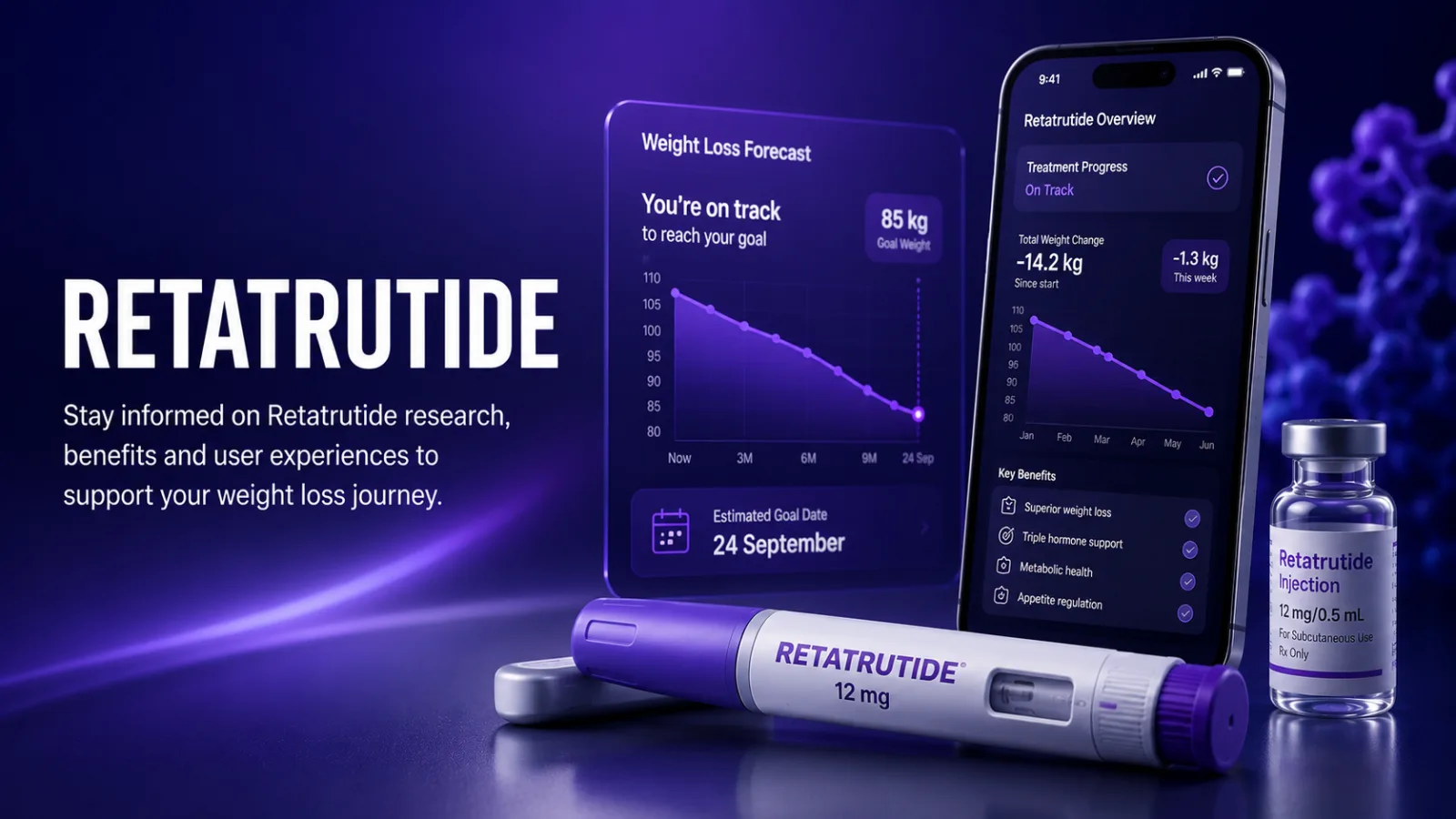
Retatrutide is one of the most closely watched experimental drugs in obesity medicine. It is being developed by Eli Lilly and acts on three gut and metabolic hormone pathways at once, which has prompted a lot of headlines about how much weight people lost in trials.
This article sets out what is actually known, where the evidence comes from, and where caution is needed. Retatrutide is still investigational. It has not been approved for sale by the FDA, the European Medicines Agency or the UK's MHRA, and outside a clinical trial there is no legitimate, approved way to obtain it. Nothing here is medical advice.
What is retatrutide?
Retatrutide (development code LY3437943) is a once-weekly injectable in the same broad family as semaglutide and tirzepatide, but it goes a step further in design. Where semaglutide targets one receptor and tirzepatide targets two, retatrutide is a triple agonist: it activates the receptors for GIP (glucose-dependent insulinotropic polypeptide), GLP-1 (glucagon-like peptide-1) and glucagon.
It is being studied for obesity, type 2 diabetes and related conditions. At the time of writing it is an experimental molecule, not a prescribable medicine.
How triple agonism might work
GLP-1 and GIP are incretin hormones. Activating their receptors tends to reduce appetite, slow stomach emptying and improve how the body handles blood sugar. Most current weight-loss injections work mainly through these routes.
The novel piece is glucagon. Glucagon is best known for raising blood sugar, but it also appears to increase energy expenditure, roughly meaning the body burns a little more. The theory behind retatrutide is that combining glucagon's effect on energy use with the appetite-lowering effects of GLP-1 and GIP could push weight loss further than incretin pathways alone. It is a plausible mechanism, and the early trial numbers are striking, but it is worth keeping in mind that glucagon activity also needs careful study for its effects on blood sugar and heart rate.
What the trials show so far
The headline data come from a Phase 2 trial led by Ania Jastreboff and colleagues, published in the New England Journal of Medicine in 2023. This was a randomised, double-blind, placebo-controlled study of 338 adults with obesity, or overweight with a weight-related condition, who did not have type 2 diabetes. Participants received retatrutide at 1, 4, 8 or 12 mg, or placebo, over 48 weeks.
At 48 weeks, the least-squares mean change in body weight was about -24.2% at the highest 12 mg dose, compared with -2.1% in the placebo group. Lower doses produced smaller, dose-dependent reductions. Among people on the highest doses, a large majority reached at least 5%, 10% or 15% weight loss.
These are early-phase results in a relatively small group, and weight loss does not equal long-term health outcomes. Phase 2 is designed to explore dosing and signal, not to confirm benefit or full safety.
Eli Lilly has since moved retatrutide into a large Phase 3 programme (the TRIUMPH trials in obesity, with TRANSCEND trials in type 2 diabetes). Early Phase 3 topline reports have continued to show substantial weight loss over longer periods. These are the trials that regulators will rely on, and the full datasets are still being reported and peer-reviewed.
Is retatrutide approved?
No. As of mid-2026, retatrutide is investigational and not approved by the FDA, the EMA or the MHRA for any use. Eli Lilly's own statements describe it as a molecule that is legally available only to people taking part in its clinical trials.
That status matters. It means there is no licensed product, no approved dose for self-administration, and no pharmacist-dispensed, quality-assured version you can legitimately buy. Approval timelines depend on the Phase 3 results and regulatory review, and they can move.
Safety signals seen in trials
In the Phase 2 trial the most common side effects were gastrointestinal, chiefly nausea, vomiting and diarrhoea. These were dose-related, mostly mild to moderate, and were eased somewhat by starting at a lower dose and titrating up slowly.
A dose-dependent increase in heart rate was also seen, peaking at around 24 weeks before declining. Increases in blood sugar were observed at the highest doses in the obesity study, which is something investigators are watching given glucagon's biology. As with any drug still in development, the complete safety picture, including rarer and longer-term effects, will only become clear as the larger Phase 3 trials report.
A word on grey-market and compounded sourcing
Because the trial numbers have generated so much interest, retatrutide is widely sold online, often labelled as a "research peptide" or "not for human consumption". This is a serious safety concern.
The FDA has been explicit that retatrutide is not an approved drug and cannot legally be used in compounding, and it has issued warning letters to sellers marketing unapproved retatrutide products. Anything bought from a peptide vendor, telehealth storefront or third-party seller sits outside the regulated supply chain. Such products have not been through FDA review for safety, effectiveness or quality, and there is no reliable way to know the actual contents, dose, sterility or storage history of what is in the vial.
The honest position is simple. If you are interested in retatrutide, the only appropriate routes are a properly run clinical trial or care under a qualified clinician once an approved product exists. Buying it on the grey market means self-experimenting with an unapproved drug of unknown quality, and that carries real risk.
Frequently asked questions
How is retatrutide different from Mounjaro or Wegovy?
Wegovy (semaglutide) acts on one receptor, GLP-1. Mounjaro/Zepbound (tirzepatide) acts on two, GIP and GLP-1. Retatrutide adds a third, glucagon. Crucially, the first two are approved medicines; retatrutide is still investigational.
How much weight did people lose with retatrutide?
In the 2023 Phase 2 obesity trial, the highest dose (12 mg) produced an average weight reduction of about 24.2% at 48 weeks, versus roughly 2% on placebo. These are early-phase findings, not a guaranteed result for any individual.
Can I get retatrutide on prescription?
Not legitimately. It is not approved, so there is no licensed prescription product. The only lawful access is through participation in an approved clinical trial.
Is it safe to buy retatrutide online?
No. Products sold online are unapproved and unregulated, with no quality control. The FDA has warned against them and taken enforcement action against sellers. The contents, dose and sterility cannot be verified.
When might retatrutide be approved?
That depends on the Phase 3 results and regulatory review, which were ongoing as of mid-2026. Any specific date would be speculation, so it is best to follow announcements from Eli Lilly and the regulators directly.
Conclusion
Retatrutide is a genuinely interesting drug. Its triple-agonist design and the size of the early weight-loss numbers are why so many people are watching it. But the evidence is still being built, the full safety profile is not yet settled, and it remains unapproved everywhere. The sensible stance is curiosity tempered with patience, and a firm no to grey-market sourcing.
If you are already enrolled in a trial, or you eventually use an approved triple agonist under clinical supervision, Weightlytic is built to help you keep a clear record: logging your dose and timing, noting any symptoms, and tracking your weight trend over time so you and your clinician can see the bigger picture. We do not supply, recommend or facilitate access to any medication.
Sources & references
- Jastreboff AM et al. Triple-Hormone-Receptor Agonist Retatrutide for Obesity — A Phase 2 Trial. New England Journal of Medicine, 2023 (PubMed, PMID 37366315)
- New England Journal of Medicine — full article (NEJMoa2301972)
- ClinicalTrials.gov — Phase 2 study of LY3437943 (retatrutide) in obesity/overweight (NCT04881760)
- Eli Lilly — Phase 3 TRIUMPH-1 obesity trial topline results (investigational status)
- U.S. FDA — FDA's Concerns with Unapproved GLP-1 Drugs Used for Weight Loss
- U.S. FDA — Warning letter on unapproved GLP-1/retatrutide products (Sept 2025)
Related articles
Track your weight loss with WeightLytic.
AI forecasting, GLP-1 companion, and protein tracking — all in one app. Free on iPhone and Android.