Retatrutide Side Effects and Trial Status
What the retatrutide trials reported about side effects, where the drug sits in development, and a clear warning about unregulated online versions. General info, not medical advice.
By Tony Dalton · Updated
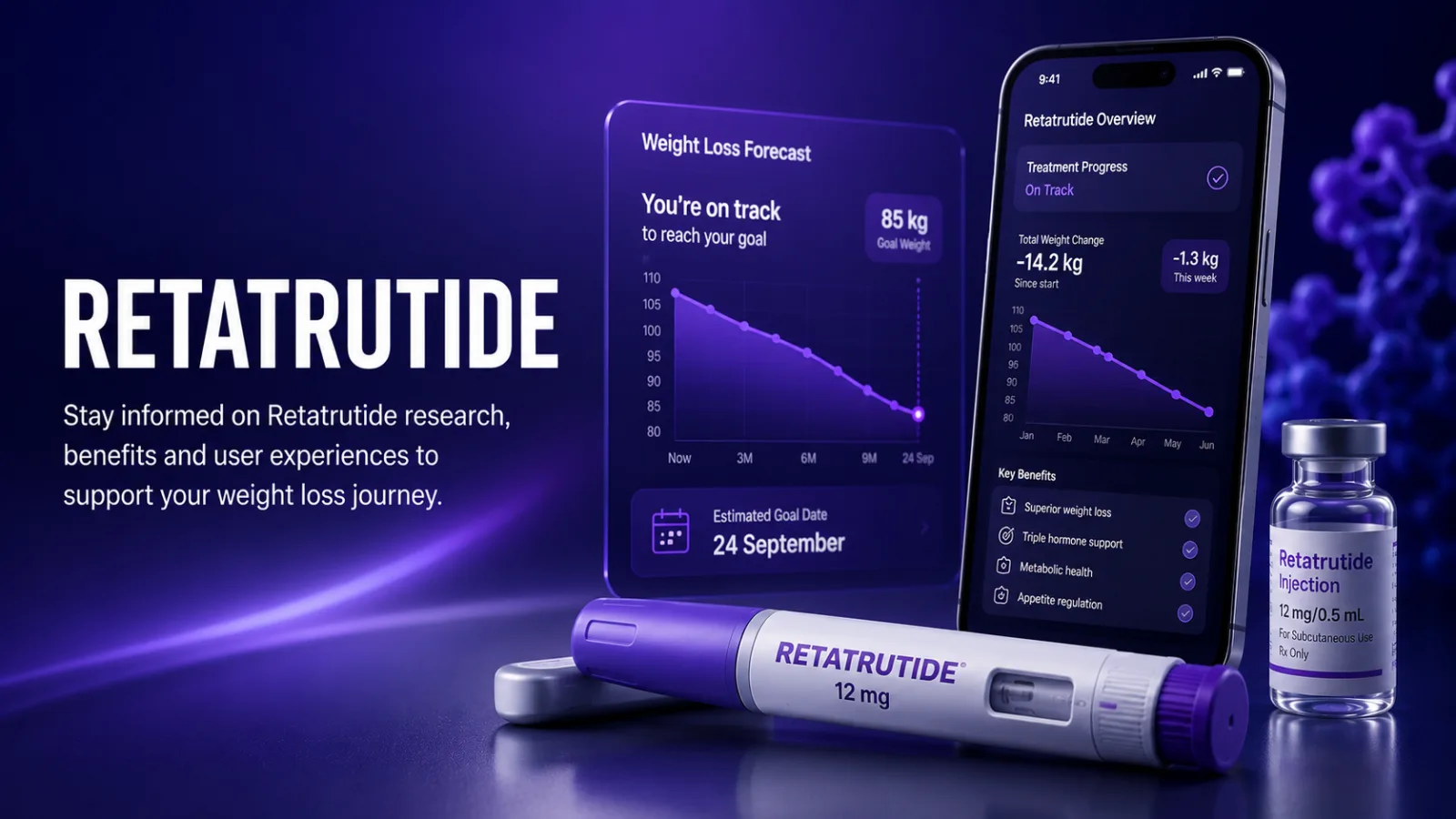
Retatrutide keeps showing up in headlines for one reason: the weight-loss numbers from its trials are bigger than anything we've seen from a single obesity drug so far. But there's a catch that gets lost in the excitement. Retatrutide isn't a medicine you can get yet. It's still being tested, the safety picture is built on trial data rather than years of real-world use, and the side-effect profile is something worth understanding properly before anyone goes looking for shortcuts.
So let's walk through what the research actually reported about tolerability, where the drug sits in development right now, and why buying anything labelled "retatrutide" online is a genuinely bad idea.
First, the honest framing: this is an investigational drug
Retatrutide (Eli Lilly's research code LY3437943) is not approved by the MHRA, the FDA, the EMA, or any other regulator. In Lilly's own words, it "is an investigational molecule that is legally available only to participants in Lilly's clinical trials." That single sentence does a lot of heavy lifting, so it's worth sitting with.
It means the side-effect data we have come entirely from controlled studies, where doses are titrated carefully, participants are screened, and everyone is monitored by clinicians. We do not yet have the long-term safety record that comes from millions of people using a drug over many years. Established medicines like semaglutide and tirzepatide have that history. Retatrutide does not, at least not yet.
If you want the broader picture of how the drug works and what makes it unusual, we've covered that separately in retatrutide explained. The short version: it activates three gut-hormone receptors at once (GLP-1, GIP and glucagon), which is one more than tirzepatide and the likely reason the appetite and weight effects are so pronounced. If you're curious how it stacks up against the medication many people are already on, retatrutide vs tirzepatide goes into that comparison.
What the Phase 2 trials reported about side effects
The most-cited safety data come from the Phase 2 obesity trial published in the New England Journal of Medicine in August 2023, led by Ania Jastreboff and colleagues. It enrolled 338 adults with obesity or overweight (without type 2 diabetes) and tested doses of 1 mg, 4 mg, 8 mg and 12 mg over 48 weeks. A separate Phase 2 trial in people with type 2 diabetes, published in The Lancet the same year, ran over 24 weeks.
Gastrointestinal effects were the main story
The most common adverse events were gastrointestinal, which won't surprise anyone familiar with this drug class. We're talking nausea, diarrhoea, vomiting and constipation. The trial reported that these effects were:
- Dose-related — more common, and more likely to be troublesome, at the higher doses.
- Mostly mild to moderate in severity rather than severe.
- Partly reduced by a slower start — beginning at a 2 mg dose instead of 4 mg helped take the edge off.
That last point matters. Titration — starting low and stepping the dose up gradually — was used deliberately to give the body time to adjust. It's the same approach used with approved GLP-1 medicines, and it's a big part of why side effects tend to ease over time rather than getting worse. If you've read our piece on managing GLP-1 side effects, the playbook here looks familiar: go slow, eat smaller portions, stay hydrated, and let the gut settle.
A transient rise in heart rate
The other finding worth flagging is cardiovascular. The Phase 2 obesity trial recorded dose-dependent increases in heart rate. Importantly, these peaked at around 24 weeks and then declined afterwards — so the data describe a transient bump rather than a permanent change. Glucagon-receptor activation is the likely mechanism, and it's one of the things researchers are watching closely as the larger trials read out. It's also a reminder that this is a more complex drug than a single-hormone GLP-1, and why proper medical supervision is non-negotiable.
The Phase 3 numbers so far
Lilly's TRIUMPH-1 Phase 3 results, announced in May 2026, broadly echoed the Phase 2 tolerability picture. Across doses, nausea was reported by roughly 29% to 42% of participants, diarrhoea by around 25% to 34%, and constipation by about 24% to 26%. Discontinuation because of side effects ranged from about 4% to 11% depending on dose, compared with around 5% on placebo. In other words: gastrointestinal effects are common, mostly manageable, and the higher the dose, the more likely they are.
One thing to keep in mind — these are headline figures from a press release and a Phase 2 paper, not the full long-term safety dossier a regulator will eventually scrutinise. The complete TRIUMPH programme is still running.
Where retatrutide is in development
Retatrutide is now in Phase 3, the final and largest stage of testing before a company can apply for approval. Lilly's programme is called TRIUMPH and spans several pivotal trials across obesity and type 2 diabetes, plus a separate, much larger cardiovascular-outcomes study. TRIUMPH-1, the first big obesity read-out, reported strong weight-loss results in 2026, with further trial data expected to follow.
What this means in plain terms:
- Retatrutide is not approved or on the market anywhere.
- You cannot get it on prescription — not privately, not on the NHS, not from a legitimate pharmacy.
- The only lawful way to receive it today is as a participant in one of Lilly's clinical trials.
Even with positive Phase 3 data, regulatory review takes time. Any genuine launch would come after that process, not before it.
A firm warning about "retatrutide" sold online
Because retatrutide isn't available legitimately, a grey market has filled the gap. You'll find vials advertised on social media, messaging apps and dubious websites, often dressed up as "research chemicals" or "not for human use" to dodge the rules. Please don't.
Here's the problem in concrete terms:
- You don't know what's in the vial. Purity is unverified. It could be under-dosed, over-dosed, the wrong compound entirely, or contaminated.
- You don't know the real dose. Trials worked because dosing was precise and titrated. Guessing at home removes every safeguard that made the drug tolerable.
- There's no medical oversight. No screening, no monitoring of your heart rate, no one to call if something goes wrong.
- There's no recourse. If an unregulated product harms you, there's no manufacturer accountability and no quality control behind it.
The transient heart-rate increase seen in trials is a good example of why supervision matters. In a study, that's measured and watched. With an unverified vial bought online and self-injected, it simply isn't. The potential downside isn't a slightly disappointing result — it's your safety.
What to do instead
If you're carrying excess weight and want medical help, the responsible route is a real clinician and an approved option. Several effective, regulated medications already exist and have years of safety data behind them. Tirzepatide (Mounjaro) and semaglutide (Wegovy and Ozempic) are licensed for the relevant uses and available through proper channels with monitoring.
A good starting point is an honest conversation with your GP or a registered prescriber about whether medication is appropriate for you, what it can realistically achieve, and how to manage the side effects. It helps to understand how GLP-1 medications work before that appointment so you can ask better questions.
And whatever medication route you take, the fundamentals still do the heavy lifting: a sustainable calorie deficit, enough protein, decent sleep and movement you can keep up. Medication makes those easier to stick to; it doesn't replace them.
None of the above is medical advice. It's general information to help you make sense of the headlines. Decisions about any medication should be made with a qualified clinician who knows your history.
Frequently asked questions
Can I get retatrutide on prescription in the UK?
No. Retatrutide is investigational and not approved by the MHRA or any other regulator. It isn't available privately or on the NHS. The only lawful way to receive it currently is as a participant in one of Eli Lilly's clinical trials.
What are the most common retatrutide side effects?
In the trials, the most common side effects were gastrointestinal — nausea, diarrhoea, vomiting and constipation. They were dose-related, mostly mild to moderate, and partly reduced by starting at a lower dose and titrating up. Trials also recorded a transient, dose-dependent rise in heart rate that peaked around 24 weeks and then declined.
Is retatrutide safe?
We can't say it has an established safety record, because it doesn't have one yet. The Phase 2 and early Phase 3 data look broadly consistent with other gut-hormone medicines, but long-term safety in the wider population is still being studied. That's exactly why it remains investigational and why self-sourcing it is risky.
How does retatrutide compare to tirzepatide and semaglutide?
Retatrutide targets three receptors (GLP-1, GIP and glucagon) versus two for tirzepatide and one for semaglutide, and its trial weight-loss figures have been notably high. But tirzepatide and semaglutide are approved, regulated and backed by real-world data, while retatrutide isn't available outside trials. Our retatrutide vs tirzepatide comparison covers the detail.
Is it safe to buy retatrutide from a website or social media?
No. Products sold this way have unverified purity, unknown dosing and no medical oversight, and they may be contaminated or not contain retatrutide at all. There's no quality control and no accountability if something goes wrong. If you want medical help with weight, see a clinician about an approved option.
Where WeightLytic fits in
WeightLytic is an AI weight-loss companion that brings food tracking, weight-trend forecasting and GLP-1 medication tracking into one place. We keep it honest, and we will not quote results we can't stand behind. If a tool that helps you understand your own trends sounds useful, it is free to download on the App Store or Google Play. You can also see what it does on our features page.
Sources & references
- Jastreboff AM, et al. Triple–Hormone-Receptor Agonist Retatrutide for Obesity — A Phase 2 Trial. New England Journal of Medicine, 2023.
- Rosenstock J, et al. Retatrutide, a GIP, GLP-1 and glucagon receptor agonist, for people with type 2 diabetes: a phase 2 trial. The Lancet, 2023.
- Eli Lilly. Lilly's triple agonist, retatrutide, delivered powerful weight loss in pivotal Phase 3 obesity trial (TRIUMPH-1). Press release, May 2026.
- ClinicalTrials.gov. A Study of LY3437943 in Participants Who Have Obesity or Are Overweight (NCT04881760).
Related articles
Track your weight loss with WeightLytic.
AI forecasting, GLP-1 companion, and protein tracking — all in one app. Free on iPhone and Android.